

Conversations Build Capacity Part 1
Why Student Talk Matters

In classrooms, conversation is often treated as something we get to after the learning is done, if there’s time. But student talk isn’t an add-on or a reward. It’s one of the primary ways learning happens.
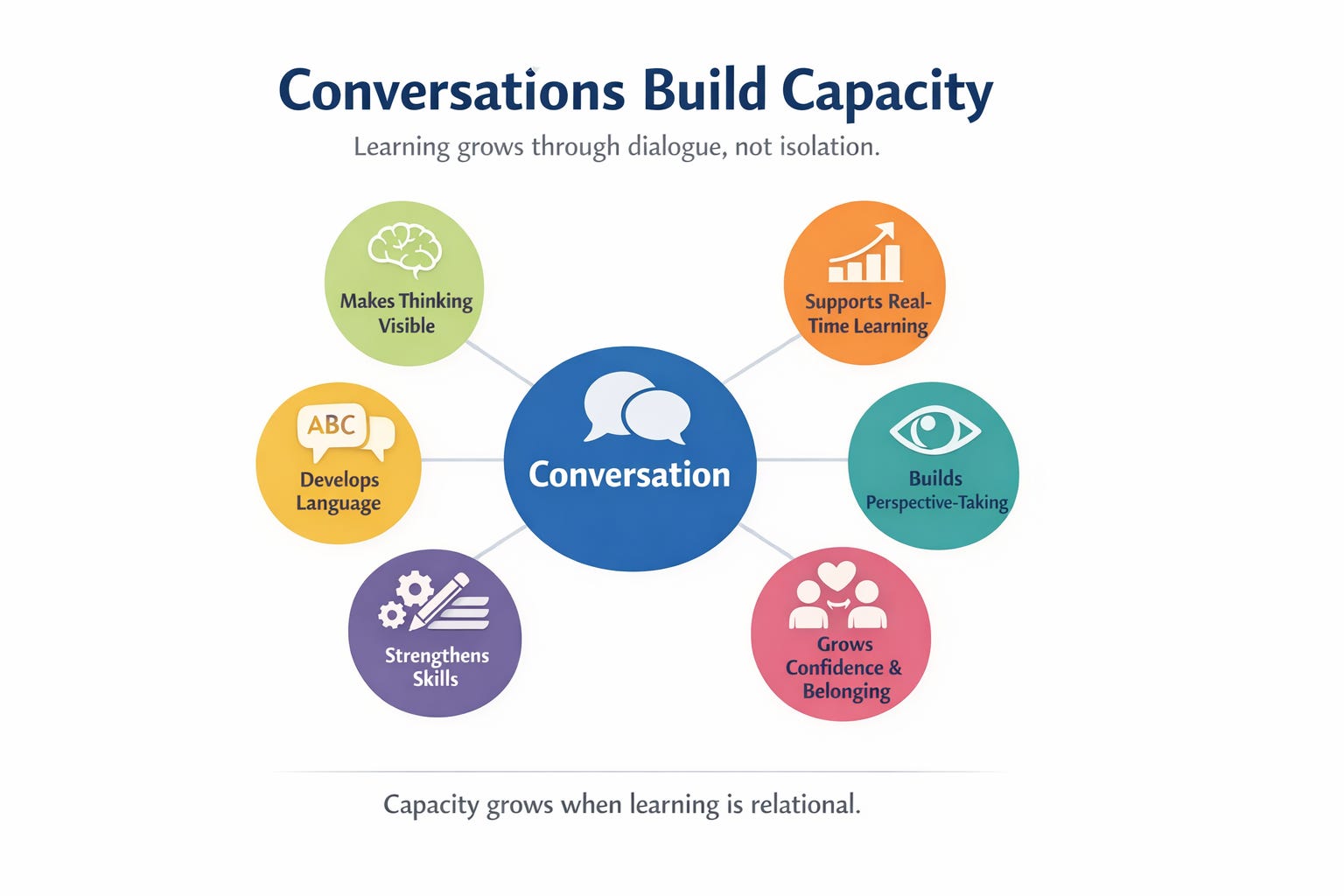
When students are given space to talk, they do far more than share answers. They make sense of ideas in real time: testing their thinking out loud, listening to others, revising their understanding, and developing the language and confidence to participate in learning communities. Conversation is where thinking becomes visible.
Through talk, process—not just product—comes into view. As students explain their ideas, we hear how they arrived at an answer, what confused them, where they changed course. Misconceptions, partial understandings, and emerging insights surface in ways written work often conceals.
Conversation also externalizes thinking in motion. Ideas aren’t fully formed when they first appear. In talk, we hear thinking being shaped, abandoned, refined, or strengthened. Pauses, hesitations, and revisions are not interruptions to learning; they are evidence of it.
Student talk makes language and understanding visible. The words students choose (academic terms, metaphors, approximations) reveal both conceptual understanding and language development. This is especially powerful for multilingual learners, whose thinking may outpace their written expression.
As students respond to one another, connections emerge. Statements like “That builds on what you said” or “This reminds me of…” signal transfer, synthesis, and growing coherence across ideas, texts, and experiences.
Conversation also reveals perspective-taking and social reasoning. Listening, agreeing, disagreeing, and reframing ideas show how students negotiate meaning together. Through dialogue, we see empathy, critical thinking, and openness to multiple viewpoints develop.
For teachers, conversation offers real-time formative assessment. We hear what students know, what they assume, and where support is needed, allowing instruction to respond in the moment rather than after the fact.
In these ways, student talk builds academic capacity by clarifying misunderstandings, deepening understanding, and connecting new ideas to prior knowledge. It also builds social and emotional capacity, as students learn that their voices matter and that learning is something we do with others.
Critical thought leads to growth when we are open to seeing through someone else’s lens, a view grounded in Vygotsky’s belief that learning develops first through social interaction before becoming internal understanding. We learn in relationship.
Just as importantly, conversation builds belonging. When classrooms intentionally make space for dialogue—through partner talk, small groups, or whole-class discussion—students experience themselves as contributors rather than passive recipients. Their perspectives help shape collective understanding.
One way I’ve seen this come to life is through a structure I call a Schmooze. While there are many ways to support meaningful student talk, what matters most is intentionality. A Schmooze creates protected space for students to prepare ideas, reflect on what matters, and engage in thoughtful conversation. It recognizes that strong speaking, listening, and collaboration skills develop through time, tools, and low-stakes practice, not by accident or osmosis.
The Schmooze is one of my learning centres, and students go through at least 3 Schmoozes in a unit of inquiry. It’s about accountable talk without the pressure of performance. Students respond to a shared stimulus, organize their thinking, and come to the discussion ready to both share and listen. Over time, these moments compound. Students become more confident, more skilled at listening deeply, and more aware of how their voices contribute to collective learning.
Another way that learning is built through conversations in my classroom is through weekly Friday Photo deconstruction. It’s a whole class, 4 step approach to decoding photos that is truly enhances through the shared experience of students observing, asking questions, making inferences, and drawing conclusions through a synthesized title for the image. This whole-class conversation is as rich as the photograph they are analysing.
Making space for conversation like this does more than meet curriculum expectations. It builds transferable skills across subject areas and affirms that learning is not always a solitary act; it can be collectively constructed.
If conversation builds student capacity in classrooms, an important question follows:
What becomes possible when we create the same intentional space for conversation among educators?
I had to share your post with a story from my intervention work. The student had failed the test and was completing missing work with me. What if the conversation had come before the test?
I was working with a student on a close read of a section of chapter 6 in Of Mice and Men. The teacher clearly wanted the student to see how Steinbeck foreshadowed Lennie’s death. As she guessed her way through, it became clear that she didn’t know Lennie died, so we reread that part talking through each sentence. She shed a tear when she realized what happened and returned to the close read. She wrote a really beautiful reflection on foreshadowing.
The link you make to multilingual learners is especially important. Talk allows thinking to surface before language is fully polished, which is exactly where so many MLLs are doing their most sophisticated work. Treating conversation as legitimate academic activity — rather than a warm-up or a filler — is a powerful equity move.
I also love the practical grounding here. The Schmooze and the Friday Photo deconstruction aren’t just nice ideas; they show what intentional design looks like. Protected space. Preparation. Low stakes. Repetition over time. That’s how confidence and skill actually grow — not through one-off “discussion lessons” but through structures that normalise thinking aloud.
If conversation builds capacity for students, it has to do the same for adults. We can’t expect teachers to develop judgement, nuance, and responsiveness in isolation. Professional learning, like student learning, deepens when thinking is made visible — through talk that is purposeful, reflective, and safe enough to include uncertainty.